
This course focuses on a “reverse-engineering” approach where the final aesthetic and functional prosthetic outcome determines the surgical placement of the implant. It covers digital wax-ups, 3D imaging integration, and biological principles for soft tissue stability.
- Mastering the “Top-Down” Philosophy: Understand why the final prosthetic outcome must dictate the surgical placement of the implant rather than bone availability alone.
- Comprehensive Data Collection: Learn to integrate clinical photography, impressions, and CBCT data to create a virtual treatment plan.
- Biomechanical Risk Assessment: Identify patient-specific factors, such as occlusal forces and parafunctional habits, that influence implant number and distribution.
- Surgical Guide Utilization: Evaluate the differences between tooth-supported, mucosa-supported, and bone-supported guides for accurate execution of the prosthetic plan.
- Material Selection: Discuss the selection of restorative materials (Zirconia, PFM, or Titanium) based on the planned prosthetic design and aesthetic zone requirements.
Short Bio for Dr. Hazem Mourad
BDS, MSc, PhD, FICOI, FAOIA, FICD, MDTFEd
Dr. Hazem Mourad is currently a Consultant of Prosthodontics and Implant Dentistry in Egypt and Dubai Academic Health Corporation where he serves also as an Assistant Clinical Professor of Prosthodontics at the Hamdan Bin Mohammed College of Dental Medicine, Mohammed Bin Rashid University of Medicine and Health Sciences. Academic background includes Masters and PhD in Prosthodontics and implant dentistry from Egypt at the years 2006 and 2014 respectively. Dr. Hazem is a Fellow of the Alexandria Oral Implantology Association in Egypt, the International Congress of Oral Implantologists in the USA, and the International College of Dentists. He is also a Member of the Faculty of Dental Trainers at the Royal College of Surgeons of Edinburgh.
This course explores the biomechanical principles and clinical workflows of overdentures as a cost-effective and hygienic functional solution. It places a special emphasis on long-term maintenance and troubleshooting for aging patients.
- Prosthetic Selection Criteria: Differentiate between tissue-supported/implant-retained and fully implant-supported overdenture designs to match patient anatomy and expectations.
- Attachment System Mechanics: Evaluate the clinical indications for various attachment systems, including Stud/Locator, Ball, and Bar-clip assemblies, focusing on retention and pivot capabilities.
- Space Management: Mastering the “Restorative Space” calculation to ensure adequate thickness of acrylic and housing for long-term structural integrity.
- Impression Techniques: Execute predictable pick-up impressions (open-tray vs. closed-tray) and the “neutral zone” technique for edentulous patients.
- Complication Management: Identify and resolve common post-insertion issues such as attachment wear, housing debonding, and soft tissue hyperplasia.
Short Bio for Dr. Hazem Mourad
BDS, MSc, PhD, FICOI, FAOIA, FICD, MDTFEd
Dr. Hazem Mourad is currently a Consultant of Prosthodontics and Implant Dentistry in Egypt and Dubai Academic Health Corporation where he serves also as an Assistant Clinical Professor of Prosthodontics at the Hamdan Bin Mohammed College of Dental Medicine, Mohammed Bin Rashid University of Medicine and Health Sciences. Academic background includes Masters and PhD in Prosthodontics and implant dentistry from Egypt at the years 2006 and 2014 respectively. Dr. Hazem is a Fellow of the Alexandria Oral Implantology Association in Egypt, the International Congress of Oral Implantologists in the USA, and the International College of Dentists. He is also a Member of the Faculty of Dental Trainers at the Royal College of Surgeons of Edinburgh.
Aimed at simplifying a complex subject, this course focuses on the relationship between the TMJ, muscles, and teeth to create biological harmony. It provides a framework for identifying occlusal risks to prevent restoration fractures and tooth mobility.
- Demystifying Terminology: Clearly define and differentiate between Centric Relation (CR), Maximum Intercuspation (MIP), and Centric Occlusion to establish a common clinical language.
- The Three Rules of Occlusion: Understand the biological requirements for occlusal stability: bilateral simultaneous contacts, axial loading, and anterior guidance.
- Anterior Guidance vs. Group Function: Evaluate the clinical indications for “Mutually Protected Occlusion” and when “Group Function” is an acceptable or necessary alternative.
- Mandibular Movement Dynamics: Analyze the Posselt’s envelope of motion and how it dictates the design of the occlusal surfaces in restorative dentistry.
Short Bio for Dr. Hazem Mourad
BDS, MSc, PhD, FICOI, FAOIA, FICD, MDTFEd
Dr. Hazem Mourad is currently a Consultant of Prosthodontics and Implant Dentistry in Egypt and Dubai Academic Health Corporation where he serves also as an Assistant Clinical Professor of Prosthodontics at the Hamdan Bin Mohammed College of Dental Medicine, Mohammed Bin Rashid University of Medicine and Health Sciences. Academic background includes Masters and PhD in Prosthodontics and implant dentistry from Egypt at the years 2006 and 2014 respectively. Dr. Hazem is a Fellow of the Alexandria Oral Implantology Association in Egypt, the International Congress of Oral Implantologists in the USA, and the International College of Dentists. He is also a Member of the Faculty of Dental Trainers at the Royal College of Surgeons of Edinburgh.
This course addresses how to manage occlusal forces specifically for implants, which lack a periodontal ligament. It uses clinical case reviews to teach participants how to design a harmonious occlusion that protects the implant-bone interface.
- Implant vs. Natural Tooth Biomechanics: Contrast the lack of a periodontal ligament (PDL) in implants with natural dentition and how this dictates different occlusal force management.
- Selecting the Right Occlusal Scheme: Analyze when to utilize mutually protected occlusion, group function, or lingualized occlusion in complex prosthetic cases.
- Minimizing Mechanical Failure: Identify how “heavy” lateral contacts lead to common implant complications such as screw loosening, ceramic chipping, or crestal bone loss.
- Occlusal Analysis: Evaluate static and dynamic occlusal contacts in full-arch implant prosthetics.
Short Bio for Dr. Hazem Mourad
BDS, MSc, PhD, FICOI, FAOIA, FICD, MDTFEd
Dr. Hazem Mourad is currently a Consultant of Prosthodontics and Implant Dentistry in Egypt and Dubai Academic Health Corporation where he serves also as an Assistant Clinical Professor of Prosthodontics at the Hamdan Bin Mohammed College of Dental Medicine, Mohammed Bin Rashid University of Medicine and Health Sciences. Academic background includes Masters and PhD in Prosthodontics and implant dentistry from Egypt at the years 2006 and 2014 respectively. Dr. Hazem is a Fellow of the Alexandria Oral Implantology Association in Egypt, the International Congress of Oral Implantologists in the USA, and the International College of Dentists. He is also a Member of the Faculty of Dental Trainers at the Royal College of Surgeons of Edinburgh.
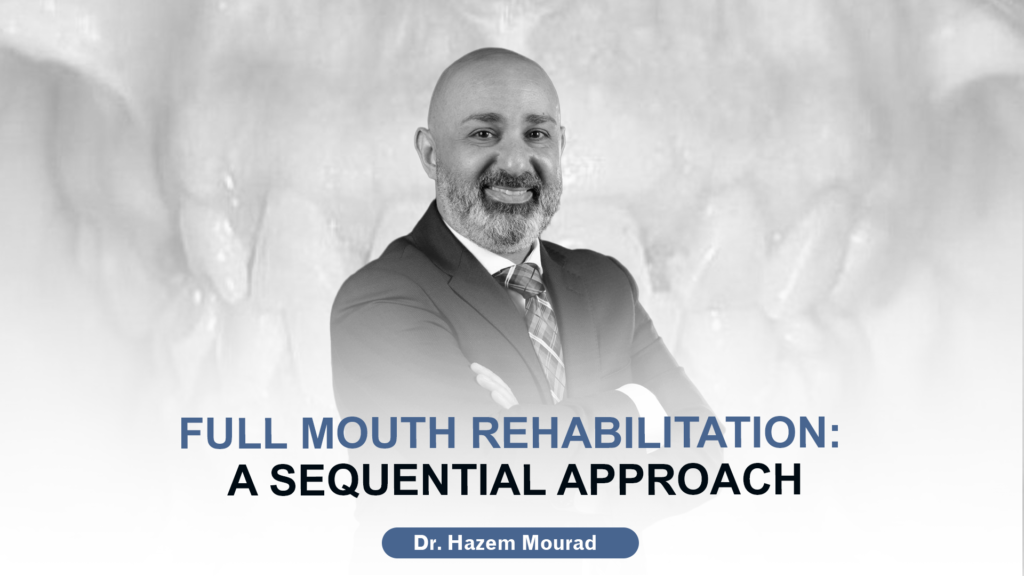
This course provides a roadmap for managing complex cases of collapsed dentition through a disciplined, sequential strategy. It emphasizes a “top-down” planning strategy to manage occlusion, aesthetics, and biology simultaneously.
- Comprehensive Case Assessment: Develop a systematic protocol for evaluating the Vertical Dimension of Occlusion (VDO) to determine the necessity of restorative increase.
- The “Six-Step” Sequencing: Master the logical progression of full mouth cases, from diagnostic wax-up and centric relation records to provisionalization and final delivery.
- Digital vs. Analog Workflows: Evaluate the integration of intraoral scanners and facebow transfers in creating a precise “Global View” of the patient’s rehabilitation needs.
- Material Selection and Biomechanics: Compare the use of monolithic zirconia, lithium disilicate, and metal-ceramics based on the available restorative space and functional requirements.
Short Bio for Dr. Hazem Mourad
BDS, MSc, PhD, FICOI, FAOIA, FICD, MDTFEd
Dr. Hazem Mourad is currently a Consultant of Prosthodontics and Implant Dentistry in Egypt and Dubai Academic Health Corporation where he serves also as an Assistant Clinical Professor of Prosthodontics at the Hamdan Bin Mohammed College of Dental Medicine, Mohammed Bin Rashid University of Medicine and Health Sciences. Academic background includes Masters and PhD in Prosthodontics and implant dentistry from Egypt at the years 2006 and 2014 respectively. Dr. Hazem is a Fellow of the Alexandria Oral Implantology Association in Egypt, the International Congress of Oral Implantologists in the USA, and the International College of Dentists. He is also a Member of the Faculty of Dental Trainers at the Royal College of Surgeons of Edinburgh.
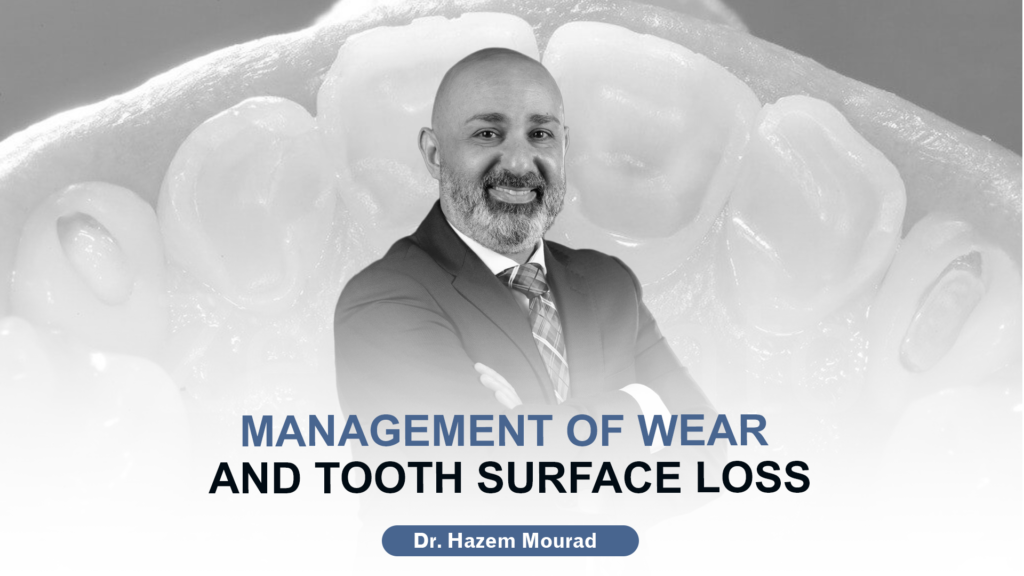
Moving from reactive treatments to proactive management, this course covers the diagnosis and etiology-based treatment of tooth wear. It provides evidence-based protocols for using minimally invasive “additive” dentistry to restore function and aesthetics.
- Differential Diagnosis of TSL: Identify and distinguish between the clinical presentations of attrition, erosion, abrasion, and abfraction to determine the primary etiology.
- Comprehensive Case Assessment: Develop a systematic protocol for evaluating the Vertical Dimension of Occlusion (VDO) to determine the necessity of restorative increase.
- Chemical vs. Mechanical Wear: Analyze the impact of dietary acids and gastric reflux versus parafunctional habits like bruxism on dental hard tissues.
- Material Selection for the Wear Patient: Evaluate the longevity and performance of composite resins, hybrid ceramics, and monolithic zirconia in high-load environments.
Short Bio for Dr. Hazem Mourad
BDS, MSc, PhD, FICOI, FAOIA, FICD, MDTFEd
Dr. Hazem Mourad is currently a Consultant of Prosthodontics and Implant Dentistry in Egypt and Dubai Academic Health Corporation where he serves also as an Assistant Clinical Professor of Prosthodontics at the Hamdan Bin Mohammed College of Dental Medicine, Mohammed Bin Rashid University of Medicine and Health Sciences. Academic background includes Masters and PhD in Prosthodontics and implant dentistry from Egypt at the years 2006 and 2014 respectively. Dr. Hazem is a Fellow of the Alexandria Oral Implantology Association in Egypt, the International Congress of Oral Implantologists in the USA, and the International College of Dentists. He is also a Member of the Faculty of Dental Trainers at the Royal College of Surgeons of Edinburgh.a
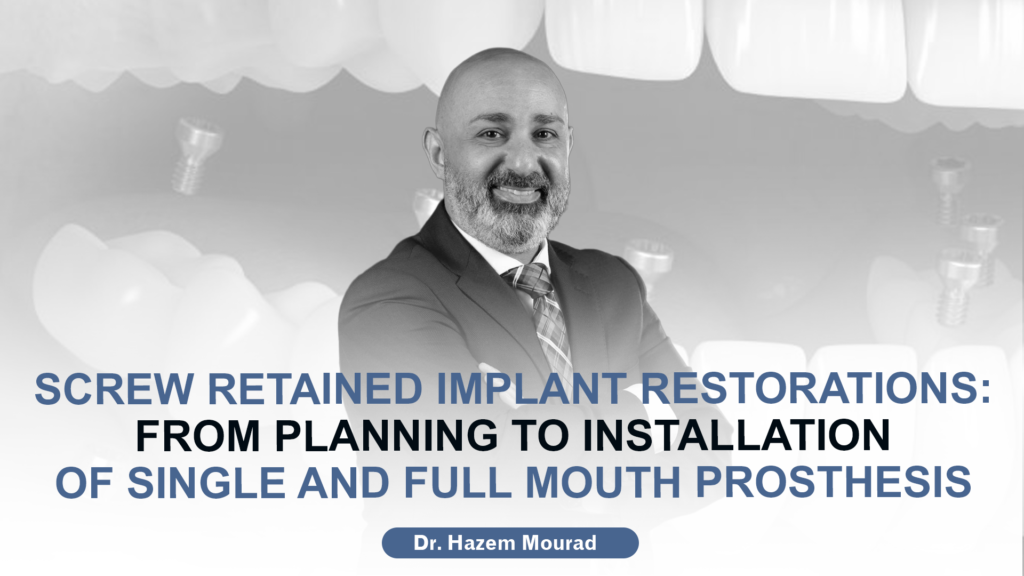
As the industry moves away from cement-retained restorations, this course provides a deep dive into the mastery of screw-retained prosthetics. It covers everything from single-unit to full-mouth “All-on-X” cases, focusing on retrievability and aesthetic access hole management.
- Biomechanics of Screw Retention: Understand the physics of “screw joint preload” and how it prevents clinical complications like screw loosening or fracture.
- Strategic Planning for Retrievability: Understand the biological and mechanical advantages of screw retention in both single-site and full-mouth scenarios, prioritizing ease of maintenance and “cement-free” protocols.
- Managing Angulation Challenges: Evaluate the use of Angulated Screw Channels (ASC) and multi-unit abutments to overcome unfavorable implant trajectories in full-arch “All-on-X” cases.
- Force Distribution and Splinting: Analyze the biomechanical differences between individual screw-retained crowns and splinted full-mouth prostheses, focusing on passive fit and tension-free delivery.
Short Bio for Dr. Hazem Mourad
BDS, MSc, PhD, FICOI, FAOIA, FICD, MDTFEd
Dr. Hazem Mourad is currently a Consultant of Prosthodontics and Implant Dentistry in Egypt and Dubai Academic Health Corporation where he serves also as an Assistant Clinical Professor of Prosthodontics at the Hamdan Bin Mohammed College of Dental Medicine, Mohammed Bin Rashid University of Medicine and Health Sciences. Academic background includes Masters and PhD in Prosthodontics and implant dentistry from Egypt at the years 2006 and 2014 respectively. Dr. Hazem is a Fellow of the Alexandria Oral Implantology Association in Egypt, the International Congress of Oral Implantologists in the USA, and the International College of Dentists. He is also a Member of the Faculty of Dental Trainers at the Royal College of Surgeons of Edinburgh.
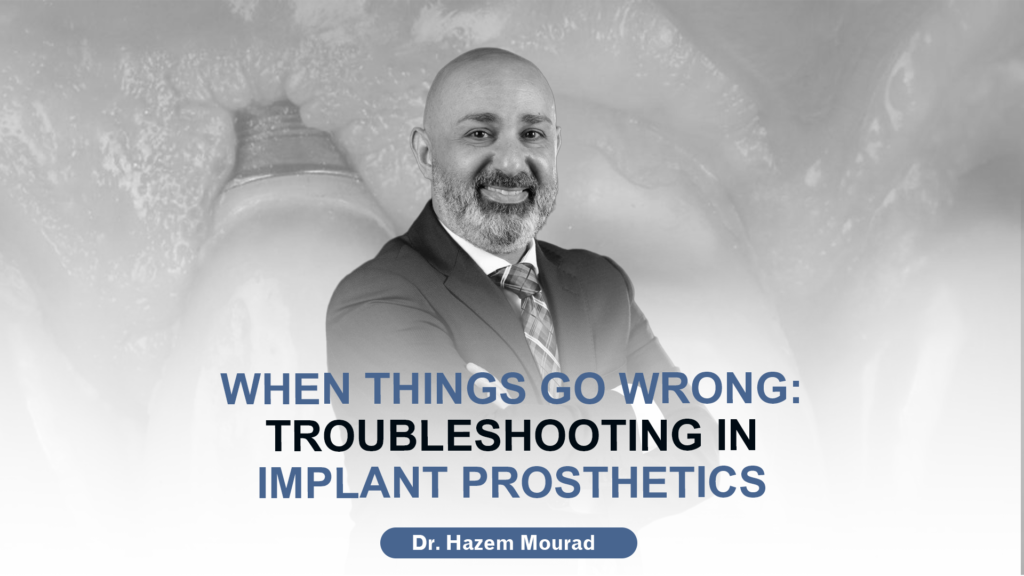
This course focuses on the reality of clinical practice by teaching clinicians how to “rescue” failing restorations. It provides systematic protocols for identifying and solving mechanical and aesthetic pitfalls, such as loose crowns or fractured screws.
- Categorizing Prosthetic Failures: Differentiate between mechanical complications (screw loosening, ceramic chipping) and biological complications (peri-implant mucositis) to determine the appropriate intervention.
- The “Retrievability” Protocol: Master techniques for accessing submerged or damaged screw heads and managing “spinning” dental implants during the restorative phase.
- Managing Aesthetic Disasters: Develop a framework for correcting “greyed” gingiva or poor implant angulation through the use of custom abutments and pink porcelain.
- Occlusal Refinement: Learn to use articulating film and digital tools to identify “heavy” contacts that lead to repeated screw loosening or prosthetic fracture.
Short Bio for Dr. Hazem Mourad
BDS, MSc, PhD, FICOI, FAOIA, FICD, MDTFEd
Dr. Hazem Mourad is currently a Consultant of Prosthodontics and Implant Dentistry in Egypt and Dubai Academic Health Corporation where he serves also as an Assistant Clinical Professor of Prosthodontics at the Hamdan Bin Mohammed College of Dental Medicine, Mohammed Bin Rashid University of Medicine and Health Sciences. Academic background includes Masters and PhD in Prosthodontics and implant dentistry from Egypt at the years 2006 and 2014 respectively. Dr. Hazem is a Fellow of the Alexandria Oral Implantology Association in Egypt, the International Congress of Oral Implantologists in the USA, and the International College of Dentists. He is also a Member of the Faculty of Dental Trainers at the Royal College of Surgeons of Edinburgh.